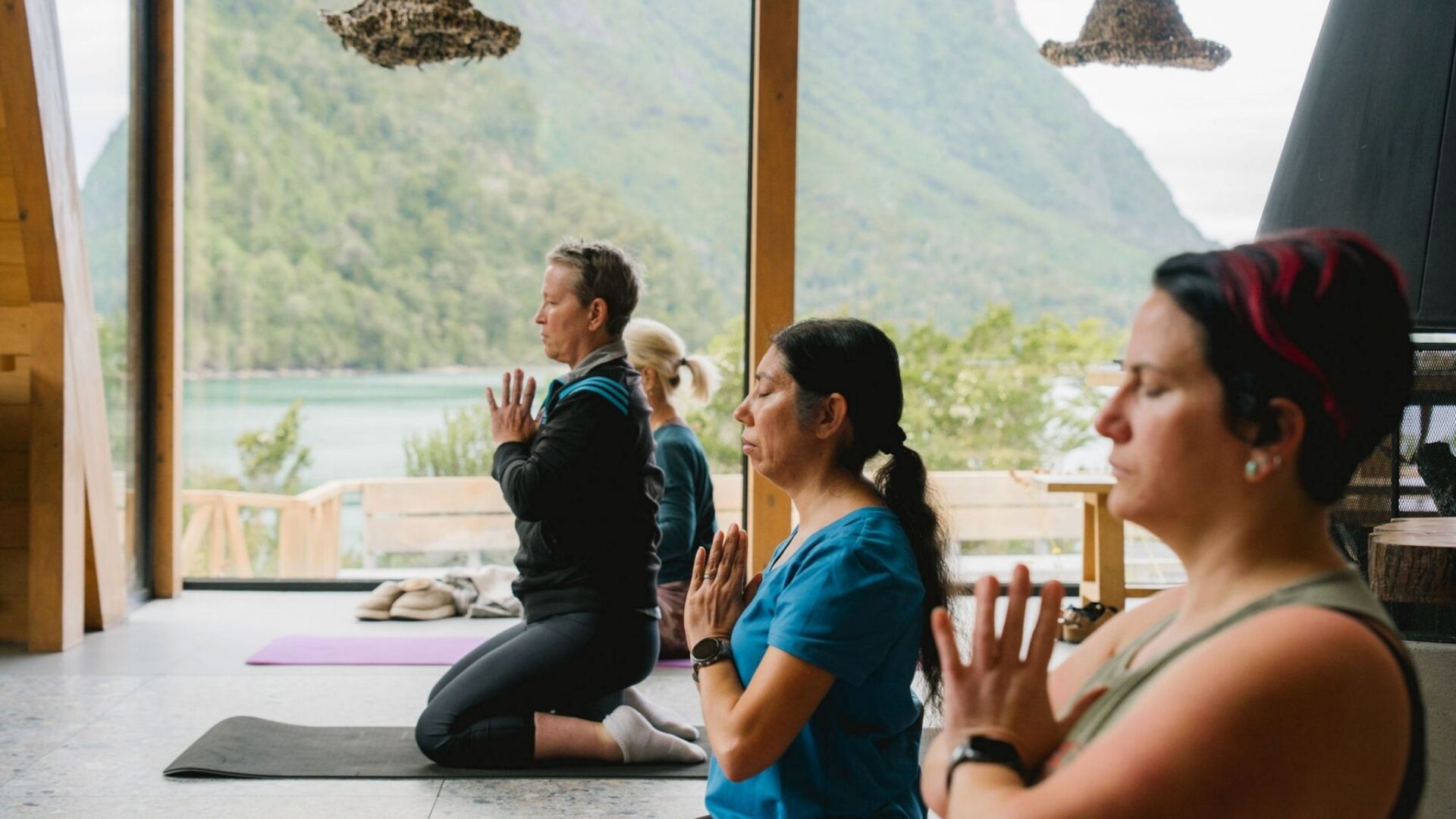
Box Breathing: A Simple Practice to Calm Your Nervous System in Minutes
13 years · 40+ retreats · 700+ women



Welcome to the Mindful Monday Series.
Box breathing is a simple breathing technique — inhale, hold, exhale, hold, each for the same count — that calms your nervous system in just a few rounds. It’s one of my favorite tools to teach, because you can do it anywhere, no experience required, and it works whether you’re frazzled at your desk, holding it together in a school pickup line, or lying awake at 2am.
If you’ve ever taken one of my classes, you might already know this one. Today I want to give it to you to keep — for the ordinary, overwhelming moments when you need to come back to yourself fast.
Table of Contents
- What Is Box Breathing?
- How Do You Do Box Breathing?
- Why Does Box Breathing Work?
- When Should You Use Box Breathing?
- Is Box Breathing Safe for Beginners?
- Calm Isn’t the Whole Point
- Frequently Asked Questions
What Is Box Breathing?
Box breathing is a breathing exercise where you inhale, hold, exhale, and hold again — each for an equal count of four. It’s also called square breathing, because the four equal sides form a box.
That’s the whole thing. Four counts in, four counts hold, four counts out, four counts hold. You repeat it for a few rounds. It’s used by everyone from Navy SEALs before high-stakes operations to people managing anxiety in a waiting room — because it’s quietly one of the most reliable ways to settle a racing mind and body.
How Do You Do Box Breathing?
To do box breathing, breathe in for four counts, hold for four, breathe out for four, and hold for four — then repeat. Here’s how to set yourself up:
- Find a comfortable seat, or lie down on your back.
- Close your eyes and take a couple of slow, ordinary breaths to arrive.
- If it feels good, place one hand on your chest and one on your belly.
Now move into the practice with me:
- Inhale for 4… 3… 2… 1.
- Hold for 4… 3… 2… 1.
- Exhale for 4… 3… 2… 1.
- Hold for 4… 3… 2… 1.
Repeat for four or five more rounds at that same steady pace. There’s no need to force the breath or make it big — soft and even is the whole point.
When you feel complete, let the counting go and return to your natural breath. Notice what’s different. Has anything shifted in your body or your mind? Maybe your shoulders dropped an inch. Maybe the noise in your head got a little quieter. Whenever you’re ready, gently open your eyes. If video is more your style, here is a guided practice on our YouTube channel.
Why Does Box Breathing Work?
Box breathing works because slow, even breathing with the breath held briefly activates your parasympathetic nervous system — the “rest and digest” branch that tells your body it’s safe to stand down.
Here’s what’s actually happening. When you’re stressed, your sympathetic nervous system runs the show: heart rate up, breath shallow and fast, body braced. Long, controlled exhales stimulate the vagus nerve, which slows your heart rate and signals your brain that the threat has passed. Breathing at this slower pace — far slower than the 12–20 breaths a minute most of us take when we’re tense — has been shown to improve heart rate variability, a key marker of a nervous system that can flex between stress and calm.
In plain terms: this isn’t a feeling you’re imagining. You’re using your breath to send a real, physical message to your body. That’s the part I love. It’s not woo — it’s your own physiology, and it’s available to you any time.
This is also the foundation of everything I teach. You can’t think clearly, make good decisions, or feel much joy from a dysregulated nervous system. Regulation comes first. Box breathing is one of the simplest places to start.
When Should You Use Box Breathing?
Use box breathing any time you feel stress rising and want to come back to steady — no special setting required. A few of the moments it helps most:
- When stress is creeping in at work and you can feel your chest tighten.
- When your patience is thinning at home and you’re about to react in a way you’ll regret.
- When you’re anxious before something hard — a call, a conversation, a decision.
- When you’re lying awake and your mind won’t stop circling.
- When you simply want to feel more grounded in your own body.
Even a few rounds can shift your mood and focus. If you can give it five to ten minutes a day — same as your morning coffee, before bed, in the car before you walk into the house — you’ll start to feel the difference not just in the moment, but in how quickly you bounce back overall.
Is Box Breathing Safe for Beginners?
Yes. Box breathing is safe and beginner-friendly — you don’t need any yoga or breathwork experience to start today. It’s one of the most accessible nervous-system tools there is.
A few gentle notes: if holding the breath for four counts feels like a strain, drop to a count of three, or even two. The numbers are a guide, not a test. If you’re pregnant, have a heart or respiratory condition, or breath-holding makes you anxious, skip the holds and simply breathe in for four and out for four — that alone calms the nervous system beautifully. The goal is ease, never effort.
Calm Isn’t the Whole Point
Here’s the part most breathwork posts leave out. We don’t regulate our nervous systems just to feel calm. We do it so we can feel everything else again — the laughter, the presence, the small ordinary pleasures that exhaustion quietly steals.
When you’re running on empty, joy doesn’t have anywhere to land. A regulated nervous system gives it room. That’s really what this work is for: not just surviving your days, but actually being awake for the good parts of them. You’re allowed to want that. You don’t have to earn it first.
This is exactly the work we go deeper into on retreat — slowing down enough that your body remembers what calm and aliveness actually feel like, with the time and space to let it sink in past a single afternoon.
Want to keep this going? Mindful Monday lands in inboxes every week — one simple, science-backed practice like this one, no fluff.
Join the Mindful Monday List →Ready for more than a few minutes? If a regulated nervous system is what you’re after, a few days of it changes everything. Come to Back to Nature in Oregon — see dates and details.
Thank you for joining me for the Mindful Monday. I hope this practice brings you a little more calm, a little more ease, and a lot more room to feel good in your own life. I’d love to hear how it landed — DM me and let me know.
Until next week,
Autumn
About the Author
Autumn Adams (E-RYT 500, YACEP) is the founder of Ambuja Yoga, where she has led 40+ women’s retreats and worked with 700+ women across Oregon, North Carolina, Sedona, Patagonia, Greece, Mallorca, and Thailand over the past 13 years. Her teaching blends yoga, nervous-system science, and adventure travel. She’s been featured in Insider, Shape, Zappos, and Asia Spa, and is the author of The Little Book of Mudra Meditations. Read more about Autumn →
Frequently Asked Questions
What is box breathing? Box breathing is a breathing exercise where you inhale, hold, exhale, and hold, each for an equal count of four. It’s also called square breathing because the four equal counts form a box. It’s a simple, fast way to calm your nervous system.
How long should I do box breathing? Even four or five rounds can make a noticeable difference. For a deeper effect, aim for five to ten minutes a day. There’s no minimum — a single round in a tense moment still helps.
Is box breathing good for anxiety? Yes. Box breathing is one of the most effective breathing exercises for anxiety because the slow, even breath and gentle holds activate the parasympathetic nervous system, which lowers heart rate and signals your body that it’s safe to relax.
What is the difference between box breathing and square breathing? There is no difference. Box breathing and square breathing are two names for the same practice — inhaling, holding, exhaling, and holding for an equal count of four.
How is box breathing different from the 4-7-8 technique? Box breathing uses an equal count for all four phases (4-4-4-4), while the 4-7-8 technique uses an inhale of four, a hold of seven, and a longer exhale of eight. Both calm the nervous system; box breathing is often easier for beginners because the counts are even.
Can beginners do box breathing? Yes. Box breathing requires no experience and can be done by anyone. If a four-count hold feels like too much, lower it to a count of three or two, or skip the holds entirely and just breathe in and out for four.
When is the best time to practice box breathing? Any time stress is rising — before a hard conversation, when patience is thinning at home, or when you’re lying awake at night. Practicing daily, even for a few minutes, also makes you more resilient to stress over time.
Why does box breathing calm you down? Box breathing calms you down because slow, controlled breathing stimulates the vagus nerve and activates the parasympathetic nervous system. This slows your heart rate and shifts your body out of the stress response and into a state of rest.
About the Author
Autumn Adams
E-RYT, YACEP, Founder of Ambuja Yoga
Autumn is a yoga teacher, retreat leader, and the founder of Ambuja Yoga. She is passionate about helping women reconnect with their inner wisdom through yoga, movement, and mindful living.
You Might Also Enjoy

Herbs for Yoga Practice: 5 Simple Ways to Deepen Calm & Connection
Bringing Ritual Back to the Practice If you’ve been wondering how to use herbs in…
Why I Moved My Yoga Mat to the Back of the Room (And What I Found There)
I’ve been practicing yoga for over two decades… nearly three! And, to be fully transparent,…
Yoga Nidra Script Inspired by Nature (Free PDF + Audio)
Discover the many benefits of yoga nidra, yogic sleep, with this yoga nidra script inspired…